الاثنين، 12 أكتوبر 2015

Iran says Washington Post's Jason Rezaian convicted


Iran's state TV reports that Jason Rezaian, a jailed Washington Post reporter, has been convicted.
The Iranian-American, the newspaper's Tehran correspondent, reportedly faces up to 10 to 20 years in prison.
Rezaian, the Post's Tehran bureau chief, had been accused of charges including espionage in a closed-door trial that has been widely criticised by the US government and press freedom organisations.
In a broadcast late on Sunday, Gholam Hossein Mohseni Ejehi, judiciary spokesman, said: "He has been convicted, but I don't have the verdict's details."
He said Rezaian and his lawyer were eligible to appeal the conviction within 20 days.
Martin Baron, Washington Post's executive editor, said in a statement: "The guilty verdict ... represents an outrageous injustice.
"Iran has behaved unconscionably throughout this case, but never more so than with this indefensible decision by a Revolutionary Court to convict an innocent journalist of serious crimes after a proceeding that unfolded in secret, with no evidence whatsoever of any wrongdoing. For now, no sentence has been announced.
"We are working with Jason's family and Iranian counsel to pursue an immediate appeal, and we expect Jason's lawyer, Leila Ahsan, also to petition for Jason to be released on bail pending a final resolution of the case."
Baron further said: "Any fair and just review would quickly overturn this unfounded verdict. Jason should be exonerated and released; he and his wife, Yeganeh Salehi, who has been out on bail, should both be granted, without delay, the full freedom that is their right."
'Farce and tragedy'
Rezaian was arrested in July 2014. He was tried in four hearings behind closed doors, the last of which was held in August.
Ejehi was quoted on Sunday by the Iranian judiciary's official website as saying: "This verdict can be appealed.
"The time for an appeal is not yet over. So the court waits, and if it doesn't receive an appeal ... the verdict becomes final."
The Washington Post has called the trial a "sick brew of farce and tragedy" and said it "has been anything but transparent and just".
Speaking to Al Jazeera earlier on Monday, Douglas Jehl, the newspaper's foreign editor, said he thought the court's decision was only "the first act".
"It's increasingly clear that the final decision about how Jason's case will be handled will be made by political authorities - not by judicial ones," he said.
"We've already heard from President Rouhani and others that Iran is willing to move Jason's case towards conclusion, if the United States will do something in return.
"So I really think that the court process that's been going on for months and months and months, in some ways, is just the first act, that the final decision needs to be made by Iran's highest authorities."

Egypt court orders release of Hosni Mubarak's sons


A court has ordered the release of the two sons of former Egyptian President Hosni Mubarak, taking into account they have completed their three-year sentences on corruption convictions.
The brothers are expected to walk free later today or tomorrow after the Cairo Criminal Court announced its verdict in the multi-million dollar embezzlement case on Monday.
Alaa and Gamal Mubarak were convicted of embezzling state funds allocated for the renovation of Egypt's presidential palaces. 
The brothers still face trial on insider trading charges, however, with the next hearing due October 17.
Their release is likely to present a dilemma for President Abdel Fattah el-Sisi, a former army chief whom opponents accuse of reviving Mubarak-era autocratic practices.
Sisi took power after ousting the country's first democratically elected President Mohamed Morsi in 2013, and won a landslide victory in last year's presidential election.
Economic crimes
"The perception is that those who were responsible for major economic crimes and human rights violations under Mubarak's dictatorship are being slapped on the hand," said Sahar Aziz, professor of law at Texas A&M School of Law, speaking to Al Jazeera, "whereas those who attempted to overthrow the regime...are being heavily penalised.
"The Egyptian revolution is yet to come, hopefully it will be a nonviolent revolution. The Egyptian people's hope to have a democratic state is yet to be realised."
Former President Mubarak, who ruled Egypt for 30 years, was convicted in the same case, in which the trio was charged with spending more than 100 million Egyptian pounds ($12.8m) of state money on their private residences.
Mubarak was ousted from power in February 2011 after 18 days of nationwide protests demanding his removal. Two months later, his sons were detained.
The brothers were released in January this year after the initial verdict was overturned. They were jailed again after the conviction was reinstated on retrial in May.
Hosni Mubarak was ordered released as he had already spent three years in pre-trial detention. He still faces a final trial on charges of responsibility for the killings of demonstrators during the 2011 uprising.

Palestinians in Israel call for strike as protests grow


Jerusalem - Palestinian citizens of Israel have announced a general strike and more protests as unrest continues to sweep Israel and the occupied Palestinian territories since the killing of two Israeli settlers in the West Bank on October 1.
The High Follow-Up Committee for Arab Citizens of Israel, an extra-parliamentary body that represents the minority community, declared a general strike for Tuesday. Arab-owned businesses, schools and other institutions will be closed.
For the past week, thousands of Palestinians in Israel have protested in Haifa, Jaffa, Nazareth and other cities and villages in Palestinian communities across the country. 

The High Follow-Up Committee said in a statement that "solidarity and protest" were necessary in the face of "fascist incitement" and attacks on the part of the Israeli government.
Majd Kayyal, media coordinator of Haifa-based Adalah Legal Centre for Arab Minority Rights in Israel who has attended protests in the last week, told Al Jazeera that the strike was motivated by the "harsh treatment" employed by Israeli police to disperse peaceful protests in present-day Israel.

Evidence mounts of Russian cluster-bomb use in Syria


Human Rights Watch has echoed accusations by Syrian activists that Russia was behind the use of new advanced cluster munitions in Syria, by dropping them from its warplanes or supplying them to the Assad government.
The New York-based group said that photographs it obtained showed that the cluster munitions were dropped on Kafr Halab, a village southwest of Syria's second city of Aleppo, on October 4.
"It's disturbing that yet another type of cluster munition is being used in Syria given the harm they cause to civilians for years to come," said Nadim Houry, Human Rights Watch's deputy Middle East director.
"Neither Russia nor Syria should use cluster munitions, and both should join the international ban without delay."


Russia launched an aerial bombing campaign against opponents of President Bashar al-Assad on September 30.
Cluster munitions contain dozens or hundreds of bomblets and are fired in rockets or dropped from the air.
Widely banned, they spread explosives over large areas and are indiscriminate in nature, often continuing to maim and kill long after the initial attack when previously unexploded bomblets detonate.
Their use in Kafr Halab coincides with the emergence of evidence that they have been used in the provinces of Aleppo, Hama and Idlib since Russia launched its intervention.
Activists' accounts
Human Rights Watch said it "cannot conclusively determine whether Russian or Syrian forces were responsible for the attack" on October 4.
It noted that neither country had banned their use.
A video posted on October 7 by activists that was reportedly taken in the town of Kafr Zeita, northwest of Hama, shows smoke trails of ground-fired rockets launched from the direction of Jabal Zayn al-Abidin and multiple subsequent explosions of submunitions in the town.


Photographs and a video posted online by local activists in October, with title text that says they were taken at Masaran village in Idlib, shows at least one unexploded AO-2.5RT submunition and the remnants of an RBK-500 canister, which can contain up to 108 submunitions.


Reuters published a photograph taken in Masaran that shows a first responder handling unexploded AO-2.5RT submunitions that local activists told the news agency were used in an attack by the Russian air force on October 7.

Human Rights Watch has documented the use of cluster munitions before in the Syrian conflict, with government forces dropping them from the air since 2012, and the Islamic State of Iraq and the Levant (ISIL) group firing them from rockets since late 2014.
According to RT television network, Russia is using in Syria "time-proven bombs and missiles equipped with state-of-the-art system guidance. Precision weapons are used from high altitudes to exclude encounters with portable air-defence systems".
Russian President Vladimir Putin told local media that Russia has the will to use these advanced weapons "if it meets the national interests of our state and the Russian people".
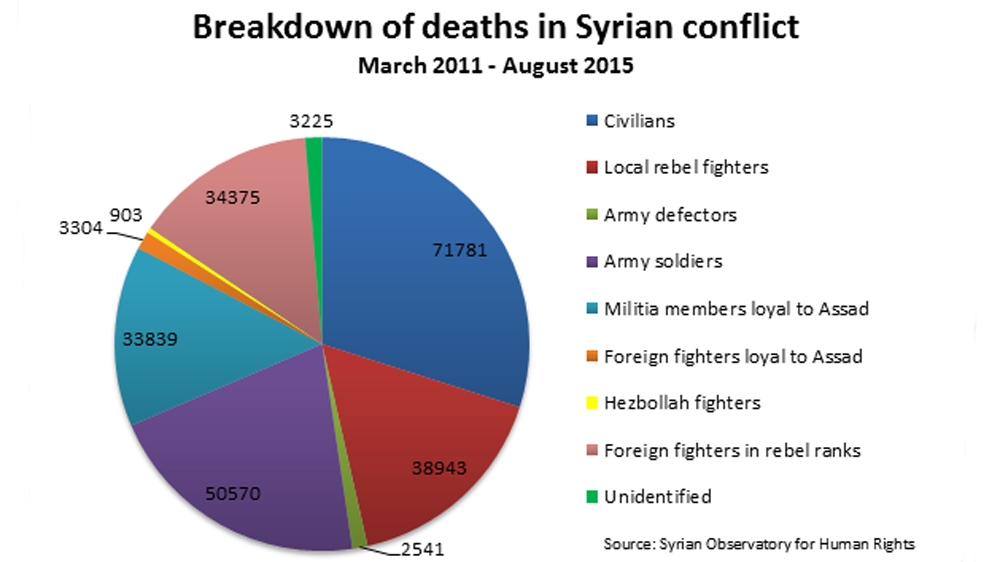
The Syrian conflict, which began as an uprising against Assad's government in 2011, has killed up to 250,000 people and forced millions to flee the country.


US airdrops ammunition to rebels fighting ISIL in Syria


United States-led coalition forces have parachuted ammunition to Syrian rebels fighting Islamic State of Iraq and the Levant (ISIL), a US official has said.
Elissa Smith, a spokesperson for the US Secretary of Defense, said on Monday that the airdrop took place in northern Syria on Sunday.
"This successful airdrop provided ammunition to Syrian groups whose leaders were appropriately vetted by the United States and have been fighting to remove ISIL from northern Syria," she said.

"The airdrop includes small arms ammunition. Due to operational security we will not have any further details about the groups that received these supplies, their location, or the type of equipment in the airdrop."
Meanwhile, Russia - which believes it is wrong of US to arm the groups that Washington calls "moderate" - intensified its air strikes on Monday in central Syria.
The Russian defence ministry said it had struck 53 alleged ISIL targets in the past 24 hours, destroying command centres, ammunition and fuel depots as well as training camps allegedly used by foreign fighters.
The ministry said the ISIL positions were in the central provinces of Homs and Hama, as well as in Latakia and Idlib. 
Russia insists it is mainly targeting the ISIL group and other "terrorists," but the multi-pronged ground-and-air offensive is being waged in areas controlled by mainstream rebels as well as the Nusra Front.
Human Rights Watch has echoed accusations by Syrian activists that Russia was behind the use of new advanced cluster munitions in Syria, by dropping them from its warplanes or supplying them to the Assad government.
The Pentagon says the vast majority of Russian strikes have been against opponents of President Bashar al-Assad, whose forces have made gains since Russian military intervention on September 30.
Government forces have pushed to regain the Sahl al-Ghab plain, which is adjacent to Latakia province, the heartland of Assad regime. Now the Syrian army is focusing its fight on the village of Kfar Nabudeh.
Capturing Kfar Nabudeh would cut off a major highway, giving the pro-government forces access to the northwestern province of Idlib.
US-Russia rivalry
Meanwhile, Syrian Kurdish forces fighting ISIL have said they are officially uniting with a mix of rebel groups.
The leaders of the new military alliance - the Democratic Forces of Syria - said they have the backing of both the United States and Russia.
Amid continued US-Russian rivalry, the United Nations envoy, Staffan de Mistura, on Monday called on Moscow and Washington for urgent agreement on Syria.
He said he would travel on to Washington "immediately after" his Moscow visit, as he struggles to set up so-called contact groups of countries with interests and influence in the Syria conflict that could help it move towards a political solution.
About 250,000 lives have been lost since the uprising began in 2011 and nearly half of the population is displaced, with millions of them fleeing out of the country for safety.
For more than a year, the United States is leading a coalition of some 60 nations that has carried out more than 7,000 drone and plane strikes against ISIL, which controls large parts of Syria and neighbouring Iraq.
The Pentagon was forced to scrap plans to train thousands of Syrian rebels in Turkey and Jordan after many failed to pass the screening process and one group of graduates gave some of their ammunitions and other gear to an Al-Qaeda affiliate.

Deaths as Israeli-Palestinian violence spirals


A series of stabbing attacks have resulted in the deaths of three alleged Palestinian attackers and resulted in several more Israelis and Palestinians being injured as violence intensifies in Israel and the occupied Palestinian territories.
Writing on Twitter, Israeli police spokesman Micky Rosenfeld said that four apparent stabbing incidents took place in Jerusalem on Monday. 
The spokesman said a Palestinian assailant was shot dead on Monday night after stabbing an Israeli soldier on a bus entering Jerusalem. The soldier was lightly injured. 
The Palestinian Authority's Ministry of Health confirmed the event on Facebook, saying that the killed man's "identity is still unknown". 
On Monday afternoon, a stabbing attack in Pisgat Zeev, a Jewish-only settlement in occupied East Jerusalem, resulted in two victims being seriously injured. "An Israeli teenager was seriously injured and hospitalised, as was a 24-year-old [Israeli] man," Rosenfeld told Al Jazeera. 
Police shot and killed one of the alleged Palestinian attackers and injured the other.
Earlier in the day, a Palestinian woman was detained and taken to the hospital after reportedly stabbing an officer near a police station. Just hours before that, Mustafa Adel al-Khatib, an 18-year-old Palestinian, was fatally shot while trying to stab an Israeli border police officer.
Protests over Israeli settlement expansion, harsh restrictions and Israeli incursions into the al-Aqsa Mosque compound in East Jerusalem has boiled over into violence earlier this month.
Meanwhile, the Israeli parliament is holding an emergency session to pass a bill to call 1,400 reservists in the Border Guard police amid rising violence.
Wave of violence
As unrest continues to spread, at least 27 Palestinians, among them suspected attackers, have been killed by Israeli forces since October 3. Another 1,990 have been injured, according to the Palestinian Authority's ministry of health.
Since the beginning of the month, four Israelis have been killed and at least 67 injured in attacks by Palestinians.
On Sunday, a Palestinian teenager was shot dead by Israeli forces during clashes at a checkpoint near Ramallah city
Ahmad Sharaka, 13, was shot in the neck with live ammunition when Israeli forces opened fire on Palestinian demonstrators outside Beit El, a Jewish-only settlement near Ramallah.
His funeral was expected to take place at Al Jalazon refugee camp later on Monday.
Heavy clashes took place on Sunday in cities and villages across the occupied West Bank, including East Jerusalem, after weeks of protests prompted by tensions over al-Aqsa Mosque compound.
Frustration has boiled over into violence as Israel continues to build Jewish-only settlements throughout the West Bank in defiance of international law.
Benjamin Netanyahu, Israel's prime minister, has blamed the violence on incitement by groups including the Islamic Movement, which runs religious and educational services for Muslims in Israel.
Netanyahu is seeking sanctions on the group, which has led a campaign accusing Israel of plotting to take over the sacred Old City compound revered by both Jews and Muslims, a claim Israel denies.
Israeli police said they had arrested a local leader of the Islamic Movement in the Bedouin Arab town of Rahat in southern Israel who was suspected of organising a group of protesters who vandalised security cameras and other property in the town on Friday.

Turkey bombings: ISIS focus of investigation, Prime Minister says


ط§ظ„ظˆظ„ط§ظٹط§طھ

ط¬ظ…ظٹط¹ ط§ظ„ط­ظ‚ظˆظ‚ ظ…ط­ظپظˆط¶ط© ظ„ط¯ظ‰ ظ…ط¯ظˆظ†ط© ظ…ط­طھط±ظپظˆظ†